gk.jpg    gf.jpg    cathedralgriffitha.jpg                       

  Doug-and-the-dean.jpg 

 Bishop Douglas Stevens, The Dean Rev. Robert Harris and the Cathedral Chapter offer you a warm welcome to the

Anglican Cathedral Church of St. Alban the Martyr 

                                                       The Dean's Easter Message
 
We gather together each year to celebrate the Pascal Mystery. This is the way of describing the events of Palm Sunday, Maundy Thursday, Good Friday and Easter. They are really one event, not four, as Jesus passes from life to death to life. As we celebrate, we do mysterious things. We eat mysterious foods, wash feet, light a fire to light candles with and scatter water. We cannot fully explain why we do any of these things. Yet as we take part in them and as we enter into the Passion of Jesus, the life of God touches us at a very deep level.
 
At the heart of the mystery is God reaching out to us, to the whole of humanity, in Jesus. 'For God so loved the world that he gave his only Son, so that everyone who believes in him may not perish but have eternal life. Indeed, God did not send the Son into the world to condemn the world, but in order that the world might be saved through him.'( John 3: 16 -17 )
 
We meet the crucified Jesus in all walks of life. The refugee, the addict, the mentally ill, people who carry paralysing pain, those who live in violent homes or the destitute. So often however, we see the love of God in people nobody seems to care for. These people are the 'suffering Christ' for us. To be reconciled to God is to be reconciled to them because it is in them that we see the love of God in the crucified Christ.
 
This is God's way of offering healing for our wounds. But the God we see in the suffering Christ on the cross, is the God of unlimited compassion for all people. Yet we need to reflect on a compassion which does not mean shutting people out but being inclusive. The suffering we see in Christ on the cross and the suffering we see in the world around us are signs that we have not at times taken on board the compassionate love of God.
 
Easter is the time to enter into the mystery of the suffering Christ and to find in him the God who loves us and who loves all people with that same love. It is so easy to get into the way of thinking that says, that God loves Christians first. But Jesus said God loved the world....the whole world, everyone without distinction. Jesus gave his life for all of us. No one is left out. When we give ourselves to those who are left out or for whom little compassion is shown, we will discover the Easter joy. We find new life when we give ourselves away, when we let God's unlimited compassion take over ourlives.
 
Christ is risen. (Alleluia!)
He is Risen indeed. (Alleluia!)
 
A Happy and Holy Easter to you all!
 
Fr Rob
Rector and Dean


The History and Building of St Alban's Church 

On 30th November, 1920, Griffith was made a Parish. The Church of St James, Hanwood (now located in Griffith's Pioneer Park following the last service on 16th May, 1971) was an old weatherboard church, relocated from the Stock Route between Bilbul ans Beelbangera. The early settlers were served by a Catechist, Mr E.P.Millard, during 1920, followed by the Reverend Wilbur Brooke as Deacon -in-Charge in 1921. Due to the growth of the town, services were also held in the picture theatre, the first being on 15th August, 1920.

The Rectory was built in 1923, and until the church hall was erected in 1927, baptisms and marriages were conducted in the Rectory lounge room. The church hall was dedicated and opened on the 22nd March 1927, by the Right Reverend A.F.Winninton-Ingram, Lord Bishop of London, having been built at a cost of 1,400 pounds.

In September 1937, the groundwork for the building of a cathedral church was laid by a Griffith Parish delegation, led by the Rector, Reverend W.G.Bennett, who travelled to Hay to meet with the Bishop of Riverina, the Right Reverend Reginald Halse, and the Diocesan Council, to suggest that the Cathedral of the Diocese should be built in Griffith. During the 1938 Synod, Bishop Halse affirmed the need for a Cathedral as a centre for worship, social service and missionary enterprise, and the Synod moved to have a parlimentary Bill prepared which would remove the restriction of the Bishop's seat to Hay or Deniliquin. However in 1939, the principle concern of the new Rector, the Venerable Victor Twigg, was that Griffith should have a church worthy of God.

Louis R. Williams, F.R.A.I.A., was commissioned to design a church in November, 1947. He was asked to design a church which would be ' spacious, lofty, seating around 300 in the Nave with ample room for extra seating, cloistered aisles, Chapel, Choir Gallery, separate Baptistry, good vestry accommodation, no doors opening to the southwest and to be free of any dust-catching ornamentation". St Alban's combines modern and traditional architecture, designed for Australian conditions and was described by Louis Williams as '20th Century Gothic".

The original plan, completed in 1948, for a longer church with a West Door Porch and more elaborate terrace was estimated to cost over 70,000 pounds. In 1953 Mr Williams modified the plan, and a tender for 44,596 pounds was accepted from Hutcherson Bros., Sydney. The groundwork began in February, 1954, and the work took nearly fifteen months to complete.

The Foundation Stone was set on 2nd may, 1954, by Archdeacon Twigg, in the presence of the Lt Governor and Chief Justice of N.S.W. the Hon. Kenneth Street and Bishop H.G. Robinson, fifth Bishop of Riverina.

On Saturday, 16th April, 1955, the Church was opened and dedicated with a fanfare of trumpets greeting the Bishop and was attended by a crowd of approximately 750 people seated in the church and 1200 outside. On Sunday 17th April the Bishop celebrated Holy Communion for the first time in the new church.

St Alban's was dedicated 'To the Glory of Godand in Memory of the Fallen' and in 1956 the Archbishop of Brisbane dedicated the Honour Roll containing the names of those who gave their lives during World War ll, in the presence of the High Commissioner for the United Kingdom.

During 1984 the Diocese of Riverina celebrated its Centenary.

The first Bishop of Riverina the Right Reverend Sidney Linton was consecrated in St Paul's Cathedral, London on the 1st May 1884. Bishop Linton was then enthroned in 'Old St Paul's Hay on the 18th March 1885. The centenary celebrations took the form of a Diocesan art Exhibition, formal dinners and a bush dance and a Festival Eucharist at Dalton park Griffith with the Bishop of Bath and Wells, The Right Reverend John Bickersteth, as the special guest preacher.

On Tuesday, 1st May 1984, as part of the Centenary celebrations, St Alban's Church at Griffith became the Cathedral of the Diocese. The Right Reveerend Barry Hunter, seventh Bishop of Riverina, knocked at the West Doors three times to claim St Alban's as the Cathedral Church of the Diocese of Riverina and was placed in his Cathedra by the archdeacon of the Riverina, the Venerable G.R.Lawrence. The address was given by the Lord Bishop of Bath and Wells.

                    cathedralgriffith.jpg

In addition to being the Parish Church for Griffith, the Cathedral aims to be a focus for the life of this large diocese in regional New South Wales. The statement of purpose for the cathedral is:

To proclaim the Gospel in Word, Sacrament and action and to be a centre of excellence for worhip and service for the Diocese of Riverina.

                                         cathedralgriffithglassa.jpg

A cathedral is traditionally a place of learning and we hope to build on that traditional function by providing some information about the season's and feasts of the church year as part of this site. Just select the 'education' link under 'St Alban's Cathedral' from the menu to the left, to find out more about the liturgy in Advent. We hope also to add some information about what is involved in achieving the Bishop's Certificate, so check back soon.

                                                      cathedralgriffithglass.jpg

The Cathedral Chapter

The chapter is made up of fourteen people, clergy and lay, from the Parish and Diocese that as a group function to;

  1. Foster the development of the Cathedral as the mother church of the diocese
  2. Consult with the Bishop on the filling of any vacancy in the incumbancy of the Cathedral Parish
  3. Approve any alterations or additions to the fabric of the Cathedral or its furnishings
  4. Make recommendations to the Bishop or Parish on any matter concerning the well-being of the Cathedral.

                              ge.jpg

St Alban's Bell Ringers

  • Practice:  Tue 5:30-7:30pm
  • Service:   Sun 9:00-9:30am
  • Contact:

Change-ringing bells are made of bronze and range in size from around 50kg up to a tonne or more (Australia's heaviest weighs 2 tonnes). They are tuned to a normal diatonic scale. Each bell has a wooden wheel with a hand-made rope running round it. The rope hangs down to the ringing room below and includes a colourful woollen hand-grip called the sally. The bells are arranged so that the ropes hang down in a circle, starting with the smallest bell and finishing with the largest. A ring of bells usually consists of 5, 6, 8, 10 or 12 bells, and each bell needs one ringer to control it.A swinging bell creates a sound of harmonic richness that cannot be matched by a fixed bell struck with a hammer. Swinging bells take around two seconds per swing. This makes ordinary music impossible (think how slow the first three notes of "Jingle Bells" would have to be). Instead, bellringers have developed their own unique form of music, following special patterns (called "methods") to make the bells sound in a different order each time they swing. Sometimes we ring for several hours without ever repeating a sequence already rung. It would take over 30 years non-stop to work through all the possibilities on 12 bells! Bellringing is a group activity that combines physical coordination and mental alertness to produce the unique sounds of change ringing. This combination of mental and physical skills, teamwork, and the rich sounds that are produced, ensures a lifetime's enjoyment. Many people ring as a contribution to church and community life; others enjoy learning a traditional skill which has been passed down for centuries. Ringers everywhere enjoy the social aspects of their hobby, meeting regularly to ring bells for various occasions, including a weekly practice session.

A Guided Tour of the Cathedral
The Cathedral was constructed using bricks from Homebush, the North Shore, and Wagga Wagga, about 290,000 in all. Marseilles tiles for the main roof and shingle tiles for the Baptistry and Chapel roofs, came from Ballarat, while the tower has copper roof. The original fountain and fish pond that was positioned on the front lawn had been dedicated on the 2nd February 1975 in memory of Christine Neal Twigg, was part of the original architect’s design. This feature has since been modified.
Entering the Cathedral by the tower porch, stairs lead up to the organ/choir gallery and the bell tower. On the wall at the foot of the stairs is a full list of gifts and memorials.
Inside the interior Cathedral doors stones from St Alban’s Abbey and St Paul’s Cathedral London have been mounted. The marble from St Paul’s was part of the Reredos damaged during the Blitz. The ‘clunch’ stone used by medieval stonemasons from St Alban’s Abbey dates to the 15th Century.
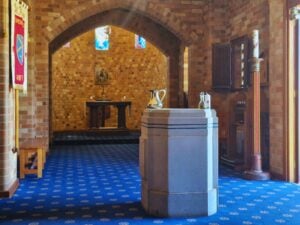
The font, situated in front of the West Doors was the gift of the mothers of the parish. It is made of Gosford sandstone with a carved panel of a child being offered to receive the gift os the Holy Spirit, by Olga Cohn of Victoria. In 1983 the font was moved from its original position in the Bapistry, now the Chapel of Angels, to the narthex.
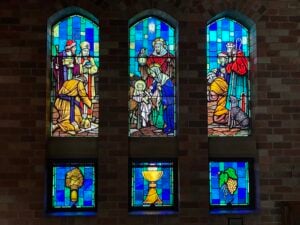
Above the West Doors is a stained glass window of the Last Supper.
The Chapel of the Angels, named for the three stained glass windows with Holy Angel motifs is furnished with a frees-standing altar and moveable seating. Hanging behind the altar is a representation of the ‘Trinity Icon’, the original of which was executed in the 15th Century by andrei Rubliv in memory of St Sergius of Radonezh.
Turning into the nave, the High Altar is the focus of the Cathedral’s worship. Behind the Altar hangs a large wooden cross which was erected in 1985. Above the cross is the East Window depicting ‘the Holy Spirit shedding a radiance over the regal figure of the Ascended lord’. At the base of the panel is the Cross, over which is the rainbow, reminding us of God’s promise of everlasting life to the faithful made possible by the sacrifice on Calvary’. The windows on either side depict the Company of Heaven. The stained glass and the mosaic honour roll were designed and supplied by Mr W. Kerr-Morgan of Brooks Robinson Pty Ltd of Melbourne.
The firnishings in the Cathedral designed by its architect Louis Williams are made from kiln dried mountain ash and were manufactured and supplied by Messrs John Trengrove and Sons of Geelong, Victoria. The carved mitre above the Bishop’s Throne a relief panel of an eagle on the lectern, two St Alban’s shields on the Dean’s Prayer Desk and the rope carving on the Chapel altar rails were crafted by Mr W. Langcake of Moorabbin, Victoria. The Bishop’s Throne and Prayer Desk were given by the men of the parish as a memorial to the late Bishop Charles Murray, fourth Bishop of Riverina.
To the right of the sanctuary will be found the Honour roll ‘To the men of the Parish who died in World War ll’.
The Blessed Sacrament Chapel is used for most weekday services. The small rose window complements the four windows representing St George (depicted as a Crusader), St Alban, St Michael,and St Mark and the three windows depicting the Nativity of Our Lord.
Looking back above the choir gallery the large rose window in mainly gold, red and blue is sugestive of the movements of a ball of fire or the sun, symbolising God’s Love and has a cente motif ‘I.H.S.’- the Holy Name of Jesus. In the central window is the figure of St Cecilia, the patron saint of music, flanked by medallions of a harp and trumpet.
The Bell Project.
The Bell Project was begun in 1991, following an inspection of the bell tower by Eayre and Smith (Overseas) Limited, who were impressed with the foresight of the architect and builders who had given proper considerations to the possibility that the tower may at some future date, be equipped with a ring of up to eight bells.
The first floor ringing room is approximately 6 ½ m high by 4 m square; the belfry is 7m high by 3 ½ m square. Access to the tower has been made easier by the addition of a new staircase.
As at July 1996, there were three bells hung in the tower with another three bells being prepared in England. The Bell Tower was dedicated during the Synod of the Diocese of Riverina on the 16th June 1996.
The Tenor Bell was originally the sixth bell at St Saviour’s Larkhall, Bath, and weighs approximately 10cwt. It was cast in 1908 by John Warner and Sons.
The fifth bell ‘ Jack McWilliam’, came from Holy Trinity, Gosport, Hants was cast in 1889 and weighs 6 ¼ cwt.
The Taylor Bell, ‘Doreen’ which is the fourth of the ring, weighs approximately 6cwt.
The Third Bell is a ‘ Warner’ bell cast in 1885 and was originally the Tenor Bell at Monks Risborough, Buckinghamshire. It is being returned and will weigh 5cwt. It will be known as the ‘Nesta’ bell.
‘Harry’ the second bell was cast in1849 by Hancock-Lakeshall and weighs 4.3.8 cwt.
A new treble bell was cast at Whitechapel Foundry in May 1996. It weighs 3.12.14cwt.
 
The Kneelers
The project to replace the origianl cloth covered kneelers in the Cathedral with tapestry kneelers was commenced in November 1983 and 376 kneelers were completed by the end of 1987.
The 30 x 20 cm kneelers were worked on the double thread canvas using 8ply knitting wool or tapestry yarn. Grosse point was chosen to give complete coverage of the canvas on both sides, increasing its durability. Each kneeler is numbered with a brief sentence describing the design on the back.
Since the Blessed Sacrament Chapel is the place of daily prayer, the forty kneelers there represent the parishes and centres from around the Diocese. These kneelers worked by people from the various centres, bear the crest or a pictorial representation of the patron saint of each church with the name of the church and the saint worked on the sides of the kneeler.
To begin with simple cross shapes were worked but covering large areas with a single colour was not only tedious but produced a very distorted fabric. Soona variety of scenes emerged. Biblical scenes, symbols of church and community life as well as native flora and fauna. The project involved a wide cross section of the community from eight to eighty year olds.
 
The Organ
The Cathedral is fortunate to house one of the few pipe organs in western N.S.W.
It is located in the gallery at the West end of the Cathedral which also is used as the Choir Gallery and is large enough to accommodate more than 50 people.
The ‘ Walker’ organ, built in 1963 is a two manual and pedal(6 stops) instrument that uses extended ranks and the Swell( 10 stops) and Great Organs( 11 stops) ‘borrow’ from each other .

The instrument is well suited to the Cathedral and provides an instrument that both supports and leads our worship as well as lending itself to the presentation of recitals.


 A Reflection on Lent
 
Welcoming all to the Sacrament of Baptism
 
Our pew sheet over the past weeks featured the signs and symbols of baptism allowing those who come for baptism to reflect on the importance of what these mean and to make a connection with the history and tradition of Baptism.
 
The Season of Lent was evolved in the life of the Early Church to prepare candidates for Baptism at Easter. This was done to make clear the vital link between baptism as the initiation into the life giving spirit of Jesus.
 
It was also the time to reconcile those who had become separate from the life of the Church by their failure and mistakes, to live out the Christian life. During Lent these penitents prepared themselves to renew the baptismal promises they had broken and be restored to the Eucharistic life of the Church.
 
In this way, the whole people of God were reminded of the need of all to live their lives in the gifts of forgiveness that comes from Christ and to constantly renew their faith. Together, the candidates, the penitents and the faithful were bound together in common shared pilgrimage to Easter: A journey of renewal, restoration and fresh beginnings .
 
From these traditions have emerged the themes of Lent:
 
Study and pray the scriptures.
Renew personal prayer life.
Seeking God's forgiveness for the past failings and mistakes.
Renew a commitment to worship of the Church community.
 
As an example of this and a reminder of who we are as the body of Christ offering hospitality, we should be drawn to the Icon by Rublev which we have hanging in the Cathedral in the 'Chapel of the Angels'. It depicts the appearance of God to Abraham at the oak of Mamre when Abraham and Sarah learnt that in their old age, Sarah would conceive and bear a son (Genesis 1 :18) Rublev painted the icon for the Monastery of the Trinity and Saint Sergius around 1410AD. Abraham's hospitality to these three strangers is a key to this Bible story, yet in the icon neither is visible. However, hospitality is present in the image: the hospitality of God .
 
When we bring children for baptism we are saying that; at the heart of the life of our community of faith is God's hospitality, centrally given expression each Sunday when we gather around the Lord's Table for Holy Communion.
 
 
Being a baptised person having received God's hospitality we then go out into the world to offer this hospitality to others- as agents of God's hospitality, we then lead others to the source of that hospitality: the living God.
 
 
May this time of Lent be for us all, an opportunity to renew and deepen our understanding of God's hospitality and to strengthen our friendship with Jesus and come to a joyful Easter.
 
Blessings,
 
Fr Rob
Rector and Dean
 
Admin Login   Parish Sites Login Site Created By www.easyeditors.com & Area I.T © Riverina Diocese